Review: Permutation City

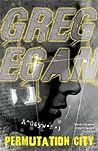
Permutation City Permutation City by Greg Egan
My rating: 5 of 5 stars

This was an excellent recommendation from my son. Written in 1992, it is prescient of the modern day, and the crevasse we are attempting to cross in the world of AI.

The book covers many philosophical points of consciousness and embodiment. People can make digital ‘copies’ of themselves and allow their alter egos to live on in a digital world that has all the depth and colour of our world, yet is a captive to physical constraints of computing power.

Copies can think, and exhibit all that one might ascribe to a conscious being. They can also work and manipulate virtual worlds, and those become sophisticated universes of their own.

At times the book’s chronology is confusing, and intentionally blurs the lines between the present, the parallel present, and the far future.

It is an engaging read, and a worthy addition to the sci-fi canon. I gave it five stars.

View all my reviews

Comments

Popular posts from this blog

Review: Then I Am Myself the World: What Consciousness Is and How to Expand It

Then I Am Myself the World: What Consciousness Is and How to Expand It by Christof Koch My rating: 5 of 5 stars Christof Koch’s latest book gives a good overview of his work in neuroscience spanning several decades. Koch always likes a bet, and talks about settling his 25 year wager with David Chalmers: in June 2023 he handed over a case of fine Madeira wine for failing to have identified the neural correlates of consciousness in the preceding 25 years. He thinks he is closer in the elusive search for the seat of consciousness, with the hunt narrowing towards the back of the neocortex, and reckons the next 25 years or so should see it pinned down further. In terms of ‘how’ consciousness works, he is now a fervent advocate of the ambitious Integrated Information Theory (IIT) of Giuilio Tononi, a theory that more than 100 consciouness researchers have branded pseudoscience. The chapter on IIT is, unsurprisingly, the most dense. The rest of the book is ...

Review: A Thousand Brains: A New Theory of Intelligence

A Thousand Brains: A New Theory of Intelligence by Jeff Hawkins My rating: 3 of 5 stars The book offers an intriguing exploration into an alternate architecture of intelligence, drawing from Hawkin's extensive background in neuroscience and computing (he helped design the Palm Pilot). The book is divided into three parts, each tackling a distinct aspect of brain function and its implications for artificial intelligence and beyond. The book's first part is a compelling dive into the world of cortical columns. It focuses on the importance of the brain's cortex (the crumpled outer layer), which is thought to have evolved later than the older 'reptilian brain', which the author dismisses throughout the book (despite the fact it keeps him and other humans alive). Hawkins suggests that if you spread the brain's 'newer' neocortex out on a table into its 2.5mm thick extra-large pizza size, you would be looking at 150,000 simil...

Review: The Pot of Gold and Other Plays

The Pot of Gold and Other Plays by Plautus My rating: 3 of 5 stars This is the second set of Plautus plays translated by E.F Watling 60 years ago. Not as good as the first The Rope and Other Plays and more ribald. That said, the title play 'The Pot of Gold' is excellent as is 'Pseudolus' . Plautus often breaks the 'fourth wall', not just with the characters giving the prologue, or the cast giving an exhortation for applause (a device used by Shakespeare in Midsummer Nights Dream and The Tempest ), but by characters in the body of the play acknowledging what the audience does or does not already no. There are some clever stage devices: in The Swaggering Soldier , a connecting door allows for a farcical appearance and disappearance of twin sisters (the same person rushing from house to house), a technique that Alan Ayckbourn would likely admire. As with his other plays, the concept of Twins (real and imagined), wily slaves, a...