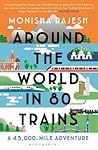
Review: Around the World in 80 Trains: A 45,000-Mile Adventure

Around the World in 80 Trains: A 45,000-Mile Adventure Around the World in 80 Trains: A 45,000-Mile Adventure by Monisha Rajesh
My rating: 2 of 5 stars

I almost gave this one star. The writer is very dismissive of her fellow travellers and of many of the places she goes. I suggest she reads some Paul Theroux or Bruce Chatwin and learns the craft of travel writing. One star was coming even before she dismissed Singapore in a poorly thought-through sentence: 'a starchy, characterless city with the superficial appeal of Dubai, and the same brutal levels of heat', yet gave pages to the (interesting) account of North Korea.


In places, the writing is poor, yet there is some humour, which raised the review to two stars.

I was angry about the Singapore comment for much of the book. She refers to a chap she met in London who had been interned at Changi during WW2, and uses his recollections and reflections a few times to add some historical context to the section on the death railway. She could have gone to the prison museum at Changi; she could have questioned the modern mix of cultures and the attraction to all things Japanese despite the war years, but she fails to scratch beneath the ‘Dubai’ surface she paints.

Her character portraits are thin, dismissive, cliched and racist - which is weird for a female writer of Indian heritage, travelling with her half-Malaysian fiancée.

Also, for a book about 80 trains, we get very little about the trains. Instead, we get a hack's perspective on the world. Her views on Japan after two weeks. Her views on Russia, Siberia and much of Mongolia and China after a week or two.

She missed an opportunity. The book could have been better. She rushed the journey, jumped to conclusions, and produced a juvenile account of train travel. She missed the connection.

I gave it two stars, and it could have been just one. Rant over.

Read Paul Theroux instead, or watch Michael Portillo or Michael Palin.

View all my reviews

Comments

Popular posts from this blog

Review: Then I Am Myself the World: What Consciousness Is and How to Expand It

Then I Am Myself the World: What Consciousness Is and How to Expand It by Christof Koch My rating: 5 of 5 stars Christof Koch’s latest book gives a good overview of his work in neuroscience spanning several decades. Koch always likes a bet, and talks about settling his 25 year wager with David Chalmers: in June 2023 he handed over a case of fine Madeira wine for failing to have identified the neural correlates of consciousness in the preceding 25 years. He thinks he is closer in the elusive search for the seat of consciousness, with the hunt narrowing towards the back of the neocortex, and reckons the next 25 years or so should see it pinned down further. In terms of ‘how’ consciousness works, he is now a fervent advocate of the ambitious Integrated Information Theory (IIT) of Giuilio Tononi, a theory that more than 100 consciouness researchers have branded pseudoscience. The chapter on IIT is, unsurprisingly, the most dense. The rest of the book is ...

Review: A Thousand Brains: A New Theory of Intelligence

A Thousand Brains: A New Theory of Intelligence by Jeff Hawkins My rating: 3 of 5 stars The book offers an intriguing exploration into an alternate architecture of intelligence, drawing from Hawkin's extensive background in neuroscience and computing (he helped design the Palm Pilot). The book is divided into three parts, each tackling a distinct aspect of brain function and its implications for artificial intelligence and beyond. The book's first part is a compelling dive into the world of cortical columns. It focuses on the importance of the brain's cortex (the crumpled outer layer), which is thought to have evolved later than the older 'reptilian brain', which the author dismisses throughout the book (despite the fact it keeps him and other humans alive). Hawkins suggests that if you spread the brain's 'newer' neocortex out on a table into its 2.5mm thick extra-large pizza size, you would be looking at 150,000 simil...

Review: The Pot of Gold and Other Plays

The Pot of Gold and Other Plays by Plautus My rating: 3 of 5 stars This is the second set of Plautus plays translated by E.F Watling 60 years ago. Not as good as the first The Rope and Other Plays and more ribald. That said, the title play 'The Pot of Gold' is excellent as is 'Pseudolus' . Plautus often breaks the 'fourth wall', not just with the characters giving the prologue, or the cast giving an exhortation for applause (a device used by Shakespeare in Midsummer Nights Dream and The Tempest ), but by characters in the body of the play acknowledging what the audience does or does not already no. There are some clever stage devices: in The Swaggering Soldier , a connecting door allows for a farcical appearance and disappearance of twin sisters (the same person rushing from house to house), a technique that Alan Ayckbourn would likely admire. As with his other plays, the concept of Twins (real and imagined), wily slaves, a...